AI Hiring
08.13.2026
Technical Assessments in the Age of AI: Which Formats Still Work?

The Karat Team

AI has impacted technical assessment formats in different ways. Code tests and take-home assessments now provide less reliable hiring signals. Because candidates can use AI to generate complete solutions, these asynchronous and output-based assessments offer less insight into a candidate’s true capabilities. Live interviews with a human hold up better, but they can’t measure how well a candidate works with AI. Today, the most effective assessment is live human + AI interviews, which combine human interviewers and an AI-enabled interview environment to show how candidates reason, make decisions, communicate, and use AI in real time.
Hiring leaders are feeling the impact of AI, as 71% say AI is making technical skills harder to assess. The share of U.S. leaders who are very confident that qualified candidates are the ones receiving job offers fell from 67% in 2024 to 47% in 2025.
Technical assessments are still essential to making high-quality engineering hires, but AI has changed what different formats can reliably measure. Here’s a deeper look at how each type of assessment is being affected and the format that’s most effective.
| Assessment format | Impact of AI |
| Code tests | Correctness and speed are no longer reliable indicators of technical ability, as AI can generate working code quickly |
| Take-home assessments | The final output provides less visibility into the candidate’s own skills and process |
| Live human-only interviews | Still provides a strong hiring signal, but doesn’t measure AI skills |
| Live human + AI interviews | Evaluates engineering skills and AI proficiency by mirroring modern engineering work |
Are Coding Tests Still Effective in the Age of AI?
Code tests were designed to evaluate foundational skills such as coding ability, problem-solving, and speed. For years, a candidate’s ability to quickly produce a correct solution was seen as a strong indicator of technical skill.
Now, AI tools can generate working code in seconds. As a result, quickly producing a correct solution no longer shows a candidate has the right underlying skills that the assessment was intended to measure. The candidate may have strong coding fundamentals, or they may have just used an AI coding assistant.
Are Take-Home Coding Assessments Still Reliable?Take-home assessments let companies see how candidates handle larger, more complex problems. Candidates have more time to think through the problem, make architectural decisions, write substantial code, and produce something closer to the work they would actually do on the job. However, take-home assessments have always had a major weakness.
Since the assessment isn’t completed in front of a human interviewer, it’s difficult to verify whether the work was actually done by the candidate. They may have gotten external help, whether that’s from another engineer or by looking up answers online.
AI has made this weakness easier to exploit. Candidates can not only use AI to generate code, but they can also debug problems, write tests, and create documentation. When companies only have the output to go off of, they don’t know what the candidate’s process was or the decisions they made. This is why output alone has never been a reliable hiring signal. AI has simply made it more apparent.
Do Live Technical Interviews Still Provide a Strong Hiring Signal?
Live technical interviews conducted by human interviewers have been less affected by AI because they give interviewers the ability to interact directly with the candidate. The interviewer can ask follow-up questions, dig into a candidate’s reasoning, and watch how the candidate reaches a solution. That provides valuable insight into a candidate’s problem-solving, communication, and reasoning skills.
Live human-only interviews have a major blind spot though. By prohibiting candidates from using AI, they don’t measure whether a candidate can work with AI. We’ve found that the majority of organizations (62%) still prohibit AI use in technical interviews. This creates a disconnect between the interview environment and the way that many engineers work today.
In remote interviews, it’s also more difficult to ensure candidates aren’t using AI. We’ve seen a five-fold increase in cheating detection rates over the past two years, as unauthorized assistance becomes easier due to AI tools.
This puts hiring teams in a difficult position, as they try to enforce an AI-free interview that’s difficult to verify remotely while simultaneously not being able to evaluate a skill that’s becoming more important. Instead of more aggressive detection, a better solution is to create interviews where AI use is visible, intentional, and evaluated alongside the candidate’s own reasoning.
What Is a Live Human + AI Technical Interview?
Live human + AI interviews are a new assessment format that has recently emerged to evaluate both core engineering skills and how candidates work with AI. In this type of interview:
- A human interviewer is present to observe how the candidate approaches a problem, makes decisions, and balances trade-offs.
- The candidate is given AI tools and expected to use them during the assessment.
- The interviewer is also able to see how the candidate uses AI and evaluates its output.
Because AI use is expected and visible, hiring teams don’t have to guess whether a candidate relied on undisclosed assistance. Instead of trying to create an AI-free environment that’s difficult to enforce remotely, they can see whether a candidate is able to use AI to improve the quality of their work.
Our global data shows that companies using human + AI interviews expect the best outcomes, yet only 33% of U.S. organizations use them. This format works because it’s much more representative of modern engineering work. Engineers are rarely writing code from scratch or solving problems in isolation. In fact, 84% of developers are either using or planning to use AI tools in their development process.
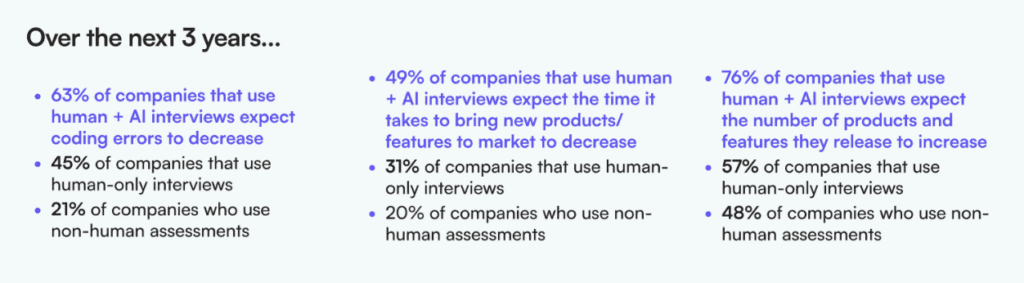
Source: https://karat.com/resource/ai-workforce-transformation-report/
What Should an AI-Ready Technical Assessment Measure?
An AI-ready technical assessment should measure both core engineering ability and AI proficiency. It should show whether candidates can:
- Reason through technical problems and explain their decisions
- Apply strong coding and system-design fundamentals
- Use AI tools appropriately and efficiently
- Evaluate, debug, and improve AI-generated code
- Identify incorrect, insecure, or incomplete AI output
- Evaluate AI-generated solutions for technical quality, security, and reliability
- Recognize when to accept, modify, or reject an AI recommendation
- Maintain independent judgment rather than relying on AI-generated answers
For enterprise organizations, assessments should also reflect role-specific expectations around security, reliability, data privacy, and responsible AI use. The goal isn’t simply to determine whether candidates can use AI, it’s to understand whether they can use it effectively while maintaining sound engineering judgment and quality.
How Should Companies Update Technical Assessments for AI?AI hasn’t made technical assessments completely ineffective, but it has made asynchronous and output-based assessments less predictive. It has also made it more important to evaluate whether your assessments are measuring the skills that actually matter in an AI-enabled world.
Although hiring leaders are experiencing AI’s impact on technical interviews, most organizations have been slow to adapt. Only 30% of organizations ranked “updating technical assessments to assess for AI” as a top priority. As engineering workflows continue to evolve with AI, relying on assessment formats designed for a pre-AI environment will make it harder to identify the engineers who are most likely to succeed on the job.
Today, the most effective assessments reflect how engineers actually work and give interviewers visibility into both the process and outcome. They also must evolve alongside technology. AI models are rapidly improving and new models are being constantly released, which can make your assessments go from effective to outdated in months.
Companies need a system for continuous content development so that assessments keep pace with how engineers actually work and what AI tools can do. For example, a regular cadence for refreshing problems, interview questions, and evaluation criteria. Since this requires resources and expertise that many organizations don’t have, many organizations partner with Karat to ensure their interview content remains up to date.
Karat makes it easy for organizations to update their technical assessments with Karat NextGen, the first human-led, AI-enabled solution designed to identify AI-ready engineering talent. By combining experienced Interview Engineers with production-grade, AI-enabled development environments, NextGen gives companies a way to evaluate AI-ready engineering talent in a realistic setting.
See how Karat NextGen evaluates AI-ready engineering talentand contact us for a demo.
FAQs
Are technical assessments still effective for hiring engineers in the age of AI?
Technical assessments are still essential for hiring, but AI has changed what different formats can reliably measure. Formats that rely on unsupervised output, like code tests and take-home assessments, have become less predictive, while live interviews that incorporate AI tools provide the strongest hiring signal.
What skills should an AI technical assessment measure?
An AI technical assessment should evaluate core engineering skills and AI proficiency. This includes how well a candidate reasons through problems, applies coding fundamentals, uses AI, and evaluates AI-generated outputs.
What is a human + AI technical interview?
A human + AI interview is a live technical interview where a human interviewer is present and the candidate is expected to use AI tools as part of the assessment. It’s designed to evaluate both core engineering skills and how well a candidate works with AI, mirroring how most engineers work today.
Are coding tests still effective in the age of AI?
Code tests can still assess foundational skills, but correctness and speed alone no longer provide enough insight into a candidate’s abilities. Assessments should also evaluate how candidates understand, debug, explain, and improve code.
Are take-home assessments still effective in the AI era?
They can be useful for evaluating how a candidate performs with larger projects, but the final output alone provides limited visibility into the candidate’s process. A live debrief can help employers assess reasoning, technical decisions, and AI use.
What technical interview format works best for hiring in the AI era?
Live human + AI interviews produce the strongest hiring signal. According to Karat’s data, companies using this format report the best expected outcomes across coding errors, time-to-market, and product output.
Related Content
AI Hiring
09.16.2026
To assess engineering skills in financial services, organizations should define the competencies needed for each role, develop interview content that measures both foundational engineering and AI skills, evaluate candidates in realistic environments, and standardize their interviews and scoring. By taking these steps, you’ll be able to reliably identify software engineers who can build secure products […]

AI Hiring
09.08.2026
Canadian banks should evaluate AI-ready contract engineers across four areas: engineering fundamentals, AI fluency, responsible AI judgment, and role-specific AI engineering skills. The strongest candidates can use AI productively, validate its output, protect sensitive data, identify security and model risks, and make sound decisions within a regulated banking environment. Banks should assess these capabilities through […]

AI Hiring
08.24.2026
In every issue of The Talent Signal newsletter, Karat Co-Founder and President Jeffrey Spector explores the trends reshaping technical hiring. From changing skill requirements to new hiring challenges, the series helps engineering leaders understand how the broader landscape is changing software engineering and what it means for building high-performing teams. One of the biggest themes […]