Industry Trends & Research
10.01.2026
How Enterprise Leaders Can Scale Technical Interviews

The Karat Team
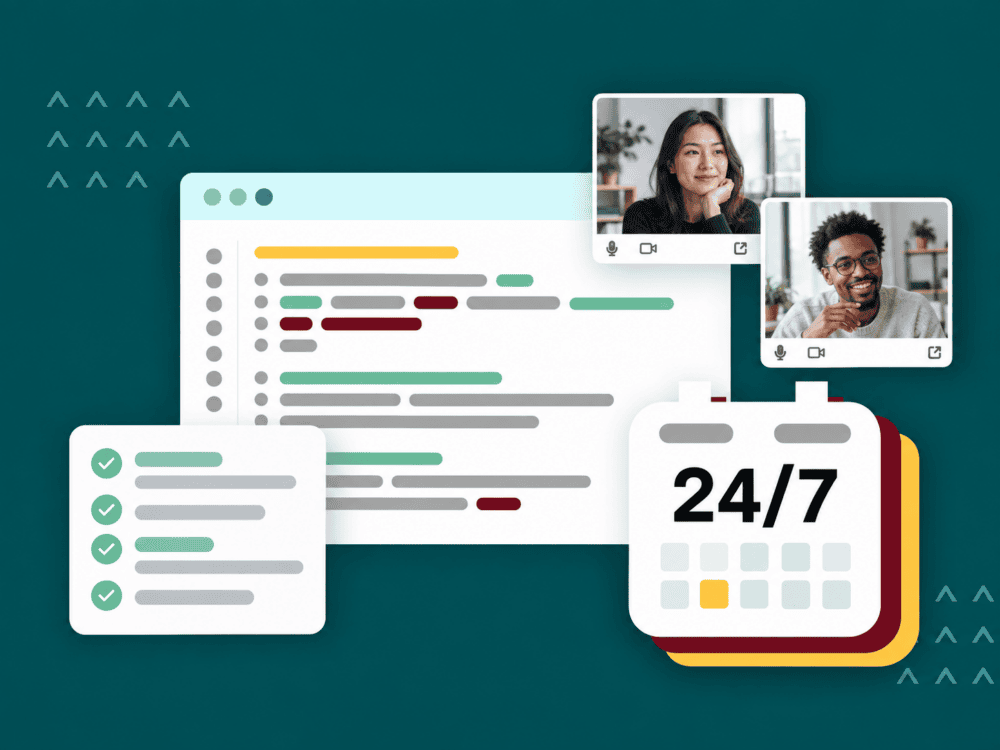

Enterprise leaders can scale technical interviews by standardizing evaluation criteria, modernizing assessments for the AI era, expanding interview availability, and adding trained interviewer capacity. This not only allows enterprises to conduct more interviews, but it also creates a consistent, high-quality hiring signal across teams, roles, regions, and talent sources without stretching engineers thin.
Scaling technical interviews is especially urgent for large technology companies and financial services organizations. Both need specialized engineering talent, often across multiple business units and geographies. Financial services leaders also operate in environments where consistency, documentation, and vendor oversight matter. As hiring volume or complexity grows, interview processes that used to work well can become harder to manage across the organization.
What Prevents Enterprise Technical Interviews From Scaling?
The most common constraints are inconsistent evaluation, assessment formats that no longer provide enough evidence in the AI era, scheduling delays, and limited interviewer capacity.
| Enterprise constraint | What it looks like at scale | Solution |
|---|---|---|
| Inconsistent evaluation | Different hiring bars across interviewers, teams, regions, or vendors | Shared competencies, rubrics, and interviewer calibration |
| Weak AI-era signal | Correct output without evidence of reasoning or AI proficiency | Live human + AI interviews that allow you to observe decision-making, debugging, and AI use |
| Scheduling delays | Candidates and interviewers have limited overlap across time zones or business hours | Broader coverage and clear scheduling ownership |
| Limited interviewer capacity | Interviews compete with engineering work | Remove duplicate evaluation and add trained interviewers |
How Can Enterprises Standardize Technical Interviews Across Teams?
Enterprises can standardize technical interviews by defining role-relevant competencies, using the same questions across candidates, applying shared scoring rubrics, and calibrating interviewers regularly. These practices help organizations maintain a consistent hiring bar.
Consistency becomes more difficult as hiring expands across teams, business units, and regions. Without a shared framework, two interviewers may evaluate the same competency differently, or an interviewer may bring their personal preferences into the assessment. Conflicting feedback can lengthen debriefs and trigger extra rounds because decision-makers don’t trust the evidence they already have.
Our research has found that centralization and standardization have become higher priorities for engineering leaders. In 2024, 46% of engineering leaders identified standardizing or centralizing hiring as a top priority — up from 38% in 2023. Among top-performing leaders, that rose to 52%.
Build a Shared Hiring Bar
Start with the capabilities required for success in each role. For candidates applying to the same role and level, use consistent interview questions and the same scoring criteria. Scoring rubrics should clearly define what each score means using observable behaviors.
For enterprises using contractors or multiple talent vendors, apply the same technical bar across talent sources where the roles require comparable skills. This gives you a more consistent way to compare candidates and evaluate vendor quality.
Train and Calibrate Interviewers
Even structured interview questions and scoring rubrics don’t create consistency on their own. Interviewers need to be trained on how to ask questions and apply the scoring rubric.
However, training shouldn’t be a one-time exercise. Enterprises need to regularly calibrate interviewers in order to maintain a consistent candidate experience and hiring bar, especially as the interviewer pool grows.
How Should Enterprises Assess Technical Skills in the AI Era?
Enterprises should assess a candidate’s reasoning, debugging, technical judgment, and use of AI — not just whether they produced working code.
AI has made it harder to rely on assessments that only measure the output. We’ve found that 71% of engineering leaders say AI is making technical skills harder to assess. That’s because a candidate can now submit the correct solution without showing which decisions they made or whether they understand the result.
Use Live Human + AI Interviews to Observe the Work
A live human + AI interview gives the interviewer visibility into how a candidate approaches a problem, weighs tradeoffs, and checks AI-generated outputs, and responds when something doesn’t work as expected.
Karat NextGen combines experienced Interview Engineers with a production-grade codebase, a VS code-based development environment, and an integrated AI assistant. This allows enterprises to evaluate foundational engineering skills and AI proficiency in an environment that more closely reflects modern engineering work.
How Can Global Enterprises Reduce Interview Scheduling Delays?
Global enterprises can reduce scheduling delays by expanding interview availability across time zones. Scheduling is difficult when candidates, recruiters, and interviewers are spread across regions. A candidate may be able to interview only before or after their current workday. A distributed interview panel may have only a small window of overlap. If there’s only a few windows of availability, candidates may have to wait days between interviews. Enterprises should give candidates more flexibility. Ideally, allowing them to schedule interviews 24/7. Even for global organizations, this is difficult to achieve. That’s why many choose to work with a talent elevation partner like Karat, who can support 24/7 interviews through its global pool of Interview Engineers.
AvidXchange cut its engineering time-to-hire in half after partnering with Karat. By giving candidates the ability to interview 24/7, including in the evenings, on weekends, and even the same day, the company reduced scheduling delays while also decreasing interviewer fatigue.
How Can Enterprises Increase Interviewer Capacity Without Overloading Engineers?
Enterprises can protect engineering capacity by removing duplicate evaluation and supplementing internal interviewers with Karat’s Interview Engineers.
Technical interviews draw experienced engineers away from product development and high-priority initiatives. The impact is especially visible in financial services. In our survey of CTOs, CIOs, VPs of Engineering, and other senior financial services technology leaders, we found that limited engineering bandwidth was the second most common hiring challenge.
Make Every Interview Stage Serve a Distinct Purpose
Map the competencies assessed at each stage. If two stages evaluate the same capability, determine whether both provide information needed for the decision. If not, removing one stage will help reduce the burden on interviewers while still producing the hiring signal that you need to evaluate a candidate.
Add External Interviewer Capacity
Enterprises can supplement internal teams with Karat’s certified Interview Engineers. Karat’s global network of interviewers provides additional capacity across regions and for hiring surges while applying your quality standards.
As hiring volume increased, Atlassian struggled to scale its interviews without pulling engineers away from their core work. This led to burnout and slower product growth. The organization used Karat to handle initial evaluations, which ensured that only candidates who had the most potential moved on to interview with Atlassian engineers. By shifting early-stage evaluations to Karat, Atlassian was able to scale its interviews while reclaiming internal engineering bandwidth.
How Karat Helps Enterprises Scale Technical Interviews
Scaling technical interviews doesn’t just require adding more interview capacity. It also involves building a process to fairly evaluate candidates, provide hiring teams a consistent signal, and give engineers time to focus on their everyday work.
Karat helps enterprise technology and financial services leaders achieve this through standardized technical assessments and scoring rubrics, human + AI interviews, 24/7 scheduling, and experienced Interview Engineers.
Contact us to explore how Karat can help your organization scale technical interviews while maintaining a consistent hiring bar.
Frequently Asked Questions
How can enterprise leaders scale technical interviews?
Define a shared hiring bar, standardize evaluation criteria, train and calibrate interviewers, offer 24/7 interview scheduling, and add external interviewer capacity.
How can financial services companies improve technical interview consistency?
Use shared competencies, structured questions, evidence-based scoring rubrics, and ongoing interviewer calibration. Apply the same technical standards across full-time, contractor, and vendor talent to improve consistency.
How can companies reduce engineering time spent interviewing?
Give every stage a distinct purpose and remove duplicate evaluation. Supplement internal interviewers with external interviewers, while maintaining shared scoring standards.
How can enterprises assess AI-ready engineering talent?
Assess foundational engineering skills together with AI proficiency. Observe how candidates reason through problems, explain decisions, validate AI-generated output, and identify errors in a realistic development environment.
What is a scalable technical interview process?
A scalable technical interview process maintains a consistent hiring bar and candidate experience as interview volume, role complexity, or geographic reach grows. It combines shared standards, trained interviewers, sufficient scheduling capacity, and measurable quality controls.
Related Content

AI Hiring
10.08.2026
90% of U.S. technology leaders are using AI to increase output without reducing engineering headcount, while 75% globally say a strong engineer is worth at least 3x their compensation SEATTLE, October 8, 2026 – AI is increasing the capacity of engineering organizations, but technology leaders are largely using those productivity gains to build more rather […]
AI Hiring
09.16.2026
To assess engineering skills in financial services, organizations should define the competencies needed for each role, develop interview content that measures both foundational engineering and AI skills, evaluate candidates in realistic environments, and standardize their interviews and scoring. By taking these steps, you’ll be able to reliably identify software engineers who can build secure products […]

AI Hiring
08.24.2026
In every issue of The Talent Signal newsletter, Karat Co-Founder and President Jeffrey Spector explores the trends reshaping technical hiring. From changing skill requirements to new hiring challenges, the series helps engineering leaders understand how the broader landscape is changing software engineering and what it means for building high-performing teams. One of the biggest themes […]