AI Hiring
10.27.2026
Will AI Replace Software Engineers? What New Research Reveals

Gordie Hanrahan

AI is not yet replacing software engineers, according to most organizations surveyed in Karat’s 2026-2027 AI Workforce Transformation Report. In the U.S., 90% of tech leaders say they’re maintaining or growing engineering headcount while using AI to do more. This indicates that companies are using the productivity gains from AI to build more, rather than reducing team size.
However, AI’s impact on software engineering is more complicated than this. Two-thirds (67%) of leaders report longer time to market, and 44% report more coding errors. Generating code faster doesn’t automatically mean shipping software faster, as bringing software to market still requires time, judgment, and coordination.
To truly understand the debate over AI replacing software engineers, let’s take a closer look at the relationship between productivity, output, and talent.
Why Aren’t AI Productivity Gains Translating Into Fewer Engineers?
Over the last three years, the dominant narrative around AI and engineers has been:
More productivity → Fewer people → Lower costs
Our survey indicates a different reality:
More productivity → Flat or growing headcount → More output
The concept behind this dynamic is the Jevons paradox. When a resource becomes more efficient to use, total consumption can increase as additional uses become economical.
If AI reduces the effort required to generate code, projects that were previously too expensive or time-consuming become feasible. Companies can pursue more ideas, build more prototypes, develop more internal tools, and work through backlogs. That’s why most organizations are reinvesting productivity gains into more software, rather than banking it as lower headcount.
How Is AI Changing Headcount, Hiring Demand, and Software Output?
AI’s impact on software engineering jobs goes beyond headcount, though. To fully understand its impact, we need to look at three measurements:
- Headcount: How many engineers does an organization employ?
- Hiring demand: Which engineering roles and skills does an organization need to add or reduce?
- Software output: How much is the organization producing?
These measures don’t necessarily move together. For example, a company can produce more software with the same team size while increasing demand for senior engineers and reducing hiring for entry-level roles. This is reinforced by our findings, which show how AI is impacting these three measures differently.
- Headcount is holding or growing. Sixty-six percent of tech leaders increased output with the same headcount, while 24% are increasing output and headcount. Only 10% report the same output with less headcount.
- Software output is rising. Eighty-two percent report increased product and feature volume over the past year.
- Hiring demand is shifting. Organizations are investing more in senior talent. Over the next three years, 60% of leaders expect senior individual contributor (IC) roles to increase and 46% expect forward-deployed engineers to grow. Entry-level roles face the most pressure, with only 15% expecting an increase.
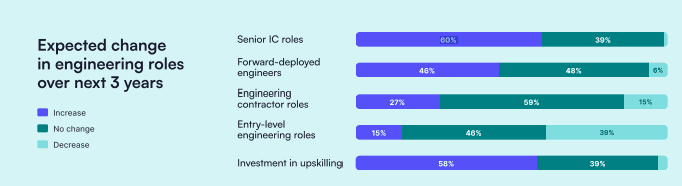
Even if AI doesn’t reduce overall engineering headcount, it may change the composition of teams. The traditional engineering pyramid may be turning into more of a diamond, with greater emphasis on more experienced engineers and less at the entry or junior levels.
Why Doesn’t More Code Automatically Mean Faster Delivery?
If AI is helping teams produce more code, why do 67% of leaders report longer time to market and 44% report more coding errors? Making one part of a system faster doesn’t necessarily make the whole system faster, and code generation is only one part of bringing software to market.
“One of the things I’ve learned running large technology organizations is that removing one constraint usually exposes another. AI can dramatically increase the capacity of individual engineers, but the rest of the organization doesn’t automatically accelerate with them. As engineering capacity grows, the bottleneck may move to product, governance, testing or decision-making. That’s why more engineering output doesn’t necessarily translate directly into faster business outcomes,” said John Burns, former CIO.
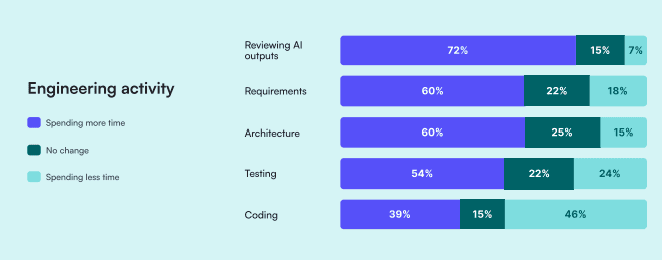
Our survey shows that the bottleneck is moving to other areas, such as reviewing AI output, gathering and refining requirements, designing systems, and testing.
What This Means for Engineering Workforce Planning
AI’s impact on engineering isn’t simply exchanging greater productivity for fewer people. Most leaders are using productivity gains to increase output while maintaining or expanding their engineering teams. At the same time, longer delivery times and more coding errors show that generating code is only one part of delivering software.
For workforce planning, this means leaders need to look beyond coding capacity. They should understand where delivery constraints are moving, which responsibilities still require human judgment, where additional capacity will produce meaningful returns, and how their hiring plans should change as engineering work evolves. These things will shape the size of engineering teams, as well as the skills that you should prioritize.
FAQs
Will AI replace software engineers?
Karat’s research shows that most organizations are using AI to increase software output rather than replace engineers. Among U.S. technology leaders, 90% report producing more with the same or growing engineering headcount. Just 10% report maintaining the same output with fewer engineers.
Is AI reducing software engineering jobs?
Not in aggregate, but it is changing which roles are in demand. Sixty percent of technology leaders expect senior individual contributor roles to increase over the next three years, while 39% expect entry-level engineering roles to decrease.
How does AI affect software engineering productivity?
AI can help engineers complete certain tasks faster, but those productivity gains don’t always translate into faster delivery or better quality. In Karat’s research, most U.S. leaders report greater coding output, but 67% report longer time to market and 44% report more coding errors.
How is AI changing software engineering hiring?
Organizations expect senior individual contributor roles to grow while entry-level roles face greater pressure. As AI takes on more implementation work, capabilities such as judgment, systems thinking, domain expertise, and evaluating AI-generated outputs become increasingly important. Hiring needs can therefore change even if overall engineering headcount remains stable.
What is the Jevons paradox, and how does it apply to AI in software development?
The Jevons paradox describes how making a resource more efficient to use can increase overall consumption of that resource. In software development, AI makes code cheaper to produce, so companies produce more of it. The result is companies are able to pursue more projects and features.
Related Content

AI Hiring
11.03.2026
In the age of AI, great engineers stand out not just for their coding ability, but for their judgment, systems thinking, problem framing, and ability to direct and evaluate AI. As AI takes on more execution work like coding, engineers who create the most value are those who can turn ambiguous problems into reliable technical […]

AI Hiring
10.08.2026
90% of U.S. technology leaders are using AI to increase output without reducing engineering headcount, while 75% globally say a strong engineer is worth at least 3x their compensation SEATTLE, October 8, 2026 – AI is increasing the capacity of engineering organizations, but technology leaders are largely using those productivity gains to build more rather […]
Industry Trends & Research
10.01.2026
Enterprise leaders can scale technical interviews by standardizing evaluation criteria, modernizing assessments for the AI era, expanding interview availability, and adding trained interviewer capacity. This not only allows enterprises to conduct more interviews, but it also creates a consistent, high-quality hiring signal across teams, roles, regions, and talent sources without stretching engineers thin. Scaling technical […]