Industry Trends & Research
02.26.2025
The tech talent migration: America’s newest top city for software hiring

Gordie Hanrahan
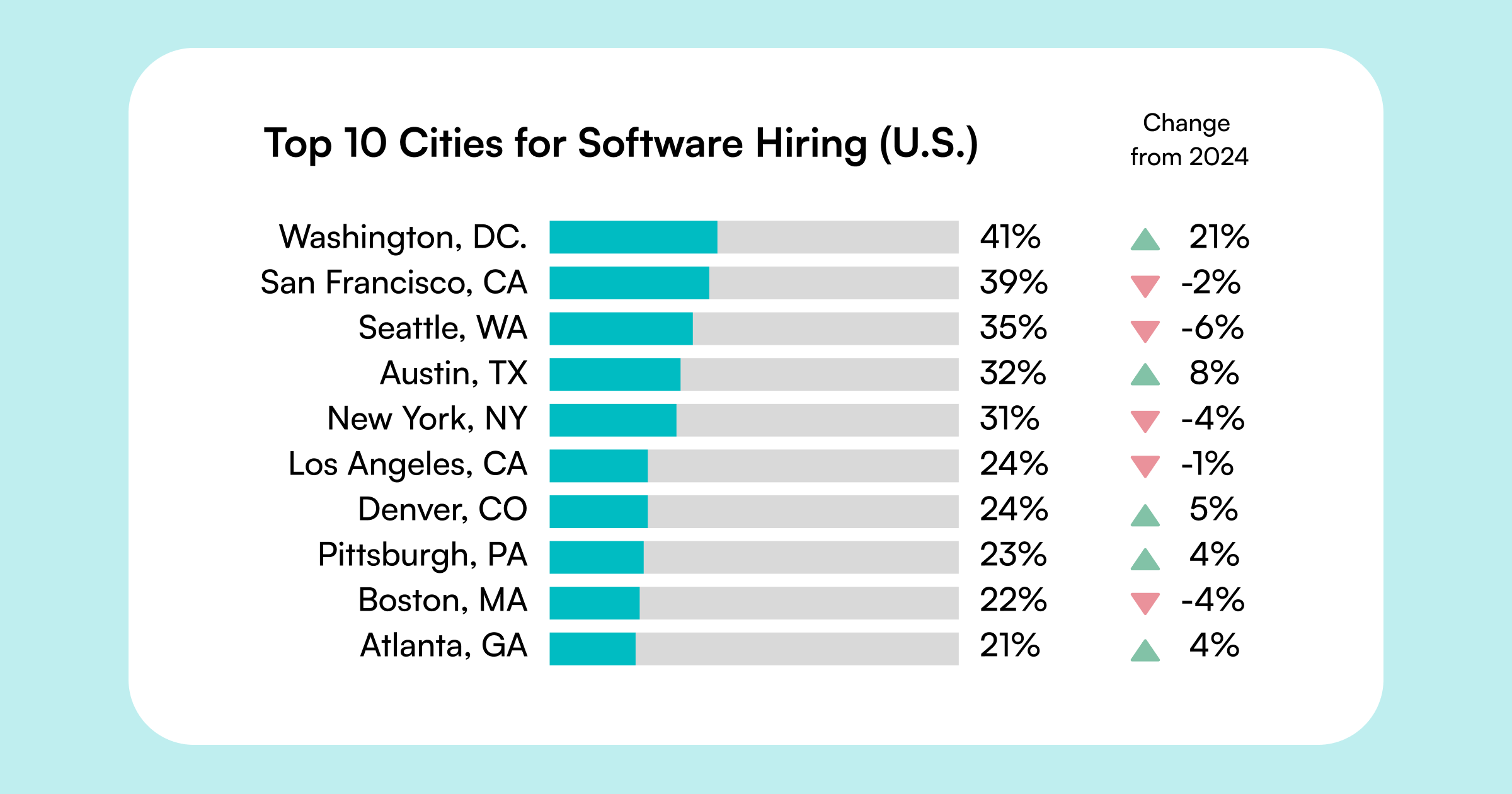

The latest tech hiring trends are showing a significant tech talent migration. Historically, elite software engineers have been concentrated in three U.S. tech hubs; San Francisco, Seattle, and New York. According to Karat’s 2025 Top Cities to Hire Software Engineers report, which is based on data from over 500,000 technical interviews, those traditional strongholds of software engineering are experiencing a multi-year exodus in tech talent. Fast-growing markets like Washington, D.C., and Austin are the main beneficiaries, with Washington replacing the San Francisco Bay Area as the top destination for elite software engineers in this year’s report.
For the third year in a row, San Francisco and Seattle saw a decline in concentrations of elite software engineering candidates — to 39% and 35% respectively. Globally, the San Francisco Bay Area maintained its 4th position while Seattle dropped from 3rd to 7th.
Over the last three years, California has seen an exodus of tech jobs. Dozens of large tech companies moved to states with less strict regulation, lower cost of living, and better tax incentives. During the pandemic, almost 250,000 people left Silicon Valley and many did not come back. Remote work became the norm, allowing employees to live in cheaper places.
Similarly, Seattle has seen some of its longstanding tech companies lay off workers or expand elsewhere. For example, Microsoft plans to vacate all of its Bellevue offices by 2028. Amazon’s return-to-office policy is also irritating workers, with 73% of surveyed employees considering quitting their jobs. However, unlike San Francisco, most of Seattle’s tech talent is homegrown, making the impact of losing top talent more acute.
Washington, D.C. is the biggest beneficiary of this talent migration, with a 41% increase in elite software engineers compared to last year. Two-thirds of Washington’s out-of-market candidates came from tech hubs, with 43% hailing from San Francisco, 12% from Seattle, and 11% from New York. Austin saw a smaller, yet significant, increase in elite talent (32%), which allowed it to jump from 13th to 8th position globally while surpassing New York in the U.S. rankings. Twenty-three percent of Austin’s out-of-market candidates come from San Francisco, 14% from New York, and 7% from Seattle.
D.C. is attracting more talent as the big tech ecosystem expands. Tech companies are putting more resources into tech lobbying, the federal government spends billions in IT, and venture capitalists invest heavily in D.C. tech companies. Meanwhile, Austin’s tech hiring is rebounding after tech giants like Google, Indeed, and Dell Technologies laid off thousands of workers in 2024. The city is poised to be at the forefront of several tech trends, and tech workers who have relocated from Silicon Valley are enjoying the diversity of professions, faster networking, affordability, and better quality of life.
To learn more about where the best engineering talent is located and migrating to, download the full ranking of the 2025 Top Cities to Hire Software Engineers.
Related Content
AI Hiring
10.27.2026
AI is not yet replacing software engineers, according to most organizations surveyed in Karat’s 2026-2027 AI Workforce Transformation Report. In the U.S., 90% of tech leaders say they’re maintaining or growing engineering headcount while using AI to do more. This indicates that companies are using the productivity gains from AI to build more, rather than […]

AI Hiring
10.08.2026
90% of U.S. technology leaders are using AI to increase output without reducing engineering headcount, while 75% globally say a strong engineer is worth at least 3x their compensation SEATTLE, October 8, 2026 – AI is increasing the capacity of engineering organizations, but technology leaders are largely using those productivity gains to build more rather […]

Industry Trends & Research
10.01.2026
Enterprise leaders can scale technical interviews by standardizing evaluation criteria, modernizing assessments for the AI era, expanding interview availability, and adding trained interviewer capacity. This not only allows enterprises to conduct more interviews, but it also creates a consistent, high-quality hiring signal across teams, roles, regions, and talent sources without stretching engineers thin. Scaling technical […]