Uncategorized
11.10.2026
Should Startups Hire Senior or Junior Engineers After Funding?

The Karat Team
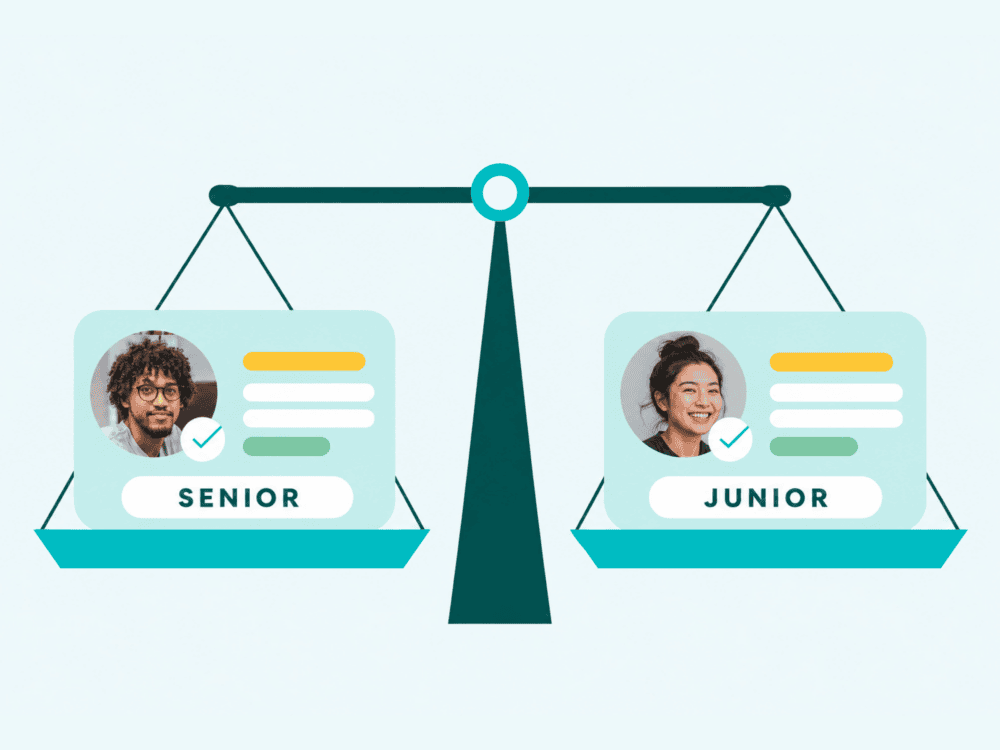

How AI is changing what startups should look for in their next engineering hire, from technical judgment to the ability to evaluate AI-generated code.
When Should a Startup Hire a Senior vs. Junior Engineer?
Decisions about senior vs. junior developer hiring should reflect your startup’s technical needs, growth plans, and ability to develop talent — not seniority alone. Senior engineers can lead architectural decisions, provide technical leadership, and own complex systems. Junior engineers may be a better fit if you have clearly defined projects and experienced engineers with time to mentor them.
Engineering hiring after funding should focus on the capabilities your startup needs most. The traditional playbook of hiring a few senior engineers and building a larger team of junior developers underneath them doesn’t necessarily work in the AI era. The better move is to hire for capabilities that create leverage and to treat years of experience as an imperfect proxy for them.
Karat’s 2026–2027 AI Workforce Transformation Report reveals how AI is influencing hiring plans. Over the next three years:
- 60% of globally surveyed leaders expect senior individual contributor (IC) roles to increase.
- 39% expect entry-level engineering roles to decrease.
- 58% expect investment in upskilling to increase.
For startups planning their next stage of growth, these findings don’t reflect the traditional playbook. Instead of simply asking whether your next hire should be senior or junior, here’s how startups should decide which roles to prioritize, what capabilities to screen for, and how to preserve a pipeline of developing engineering talent.
How is AI Changing Startup Engineering Hiring?
It’s tempting to hire quickly and maximize engineering capacity after raising a round. However, building your hiring plan solely around headcount targets doesn’t account for the capabilities that create the greatest impact.
As AI takes on more coding tasks, engineers are spending more time reviewing AI-generated outputs, refining requirements, designing systems, and testing. Generating code is becoming easier, but ensuring that the code solves the right problem and works reliably still requires human expertise. That’s why hiring for skills, rather than just years of experience, matters.
Additionally, startups should consider the constraints they’re currently facing. Prioritizing the capabilities that can help you overcome these constraints will allow you to make the most progress toward your business goals.
What Skills Should Startups Assess When Hiring Software Engineers?
Years of experience, previous job titles, and familiarity with a particular technology stack can provide useful context when screening candidates. However, they’re imperfect proxies for an engineer’s ability to deliver results in an AI-enabled environment.
Regardless of seniority, your engineering hiring strategy should assess a combination of foundational engineering skills and AI skills. This includes:
- Technical judgment and problem-solving: Can the candidate break down an ambiguous problem, identify the underlying requirements, evaluate trade-offs, and come up with an appropriate solution?
- Systems thinking and architectural reasoning: Can the candidate understand how a change affects the broader system? Can they recognize reliability, scalability, maintainability, and security concerns before those issues become expensive to fix? The depth of expertise a candidate needs will depend on the role. A senior engineer may be expected to make architecture-level decisions independently, while a junior engineer should demonstrate sound reasoning appropriate to their experience.
- AI fluency: Can the candidate use AI tools effectively to accelerate development? Can they recognize when AI-generated output is incorrect, incomplete, insecure, or poorly suited to the problem? AI fluency isn’t simply knowing which tools to use. It includes knowing how to direct AI, and evaluating and fixing its work.
- Ownership and adaptability: Can the candidate respond constructively when an approach fails, incorporate feedback, and follow a problem through to a reliable outcome? Priorities and requirements often change quickly in a startup, so these capabilities are as important as familiarity with a specific framework.
How Can Startups Develop Junior Engineers in the AI Era?
As AI absorbs more of the work that has historically helped junior engineers develop, startups face a long-term talent challenge. With demand for entry-level roles shrinking, fewer junior engineers will have the opportunity to learn and build foundational skills in a real work setting.
To mitigate this problem, startups should invest in upskilling in addition to hiring. We found that 58% of leaders expect investment in upskilling to increase over the next three years, underscoring the importance of developing the capabilities your organization needs within its existing workforce.
There are several ways that startups can help develop junior talent:
- Give junior engineers ownership of meaningful work. Junior engineers need opportunities to understand why a solution works, recognize when it fails, and make decisions independently. Assign work that builds these skills rather than having them rely exclusively on AI to complete tasks that can serve as learning opportunities.
- Create opportunities for feedback. Code reviews, debugging sessions, and mentorship can help engineers develop judgment faster. Provide engineers with feedback that highlights the reasoning behind technical decisions, rather than simply correcting the final implementation.
- Make mentorship part of workforce planning. Assign a mentor to every junior engineer and reserve time for problem-solving discussions. Microsoft’s PRAISE program, in partnership with Carnegie Mellon University, uses this structure to help early-career software engineers deliberately learn how to work through problems and test assumptions.
- Help engineers develop skills alongside AI. A study conducted by Anthropic found that how engineers use AI affects their learning. Junior developers who use AI to work as quickly as possible may hinder their skill development, especially when it comes to debugging issues. To help them improve their skills, establish guidelines for when they should use AI and when they should work through problems on their own. Encourage them to explain AI-generated code, investigate errors before asking AI for a solution, and verify outputs rather than accepting them.
Additionally, startups should remember that an entry-level engineer with strong fundamentals, sound judgment, and AI fluency may offer greater long-term value than a more experienced candidate whose skills haven’t evolved. When you have the capacity to mentor and develop junior engineers, that can strengthen your future pipeline.
How to Build Your Engineering Hiring Plan After Funding
A new funding round creates pressure to hire quickly, but the engineers you hire now will have a large impact as your startup grows. While years of experience should be a consideration, your next hire shouldn’t be solely determined by seniority. Start with the responsibilities that your next hire needs to cover. Then assess candidates for the technical fundamentals, judgment, and AI fluency those responsibilities require.
Startups also need to remember that what makes an engineer valuable is shifting due to AI. As AI takes on more execution work, skills like judgment, systems thinking, and the ability to direct AI matter more than seniority.
Before building your next engineering hiring plan, explore how AI is reshaping engineering roles and talent value.
FAQs About Startup Engineering Hiring
Should a startup hire a mid-level engineer after funding?
A mid-level engineer can be a fit when the team needs someone who can deliver independently within an existing architecture and has senior engineers who can make larger design decisions. They can take ownership of well-defined projects, contribute to problem-solving, and move work forward without requiring the same level of day-to-day guidance as a junior engineer. For startups, this can provide additional capacity while allowing senior engineers to focus on more complex challenges.
How is AI changing engineering hiring strategies for startups?
AI is shifting demand toward engineers who can solve complex problems, make sound technical decisions, effectively use AI tools, and evaluate AI output. Karat’s 2026–2027 AI Workforce Transformation Report found that 60% of technology leaders expect senior individual contributor roles to increase over the next three years, while 39% expect entry-level engineering roles to decrease. Startups should reassess which capabilities they need rather than assuming AI simply means hiring fewer engineers.
What is the best engineering team structure for a growing startup?
The right startup engineering team structure depends on the startup’s product roadmap, technical complexity, and available resources. Rather than defaulting to a traditional pyramid of senior engineers overseeing larger numbers of junior developers, startups should identify where they need technical leadership, independent execution, and opportunities to develop early-career talent.
How can startups develop junior engineers when AI handles entry-level work?
Startups should make development deliberate through mentors, bounded project ownership, regular reviews, and participation in technical decisions. Ask junior engineers to explain, test, and defend AI-assisted solutions rather than simply submit working code. Expand their responsibilities as they demonstrate stronger judgment and independence, and account for mentorship time in the team’s delivery plan.
Related Content
AI Hiring
09.16.2026
To assess engineering skills in financial services, organizations should define the competencies needed for each role, develop interview content that measures both foundational engineering and AI skills, evaluate candidates in realistic environments, and standardize their interviews and scoring. By taking these steps, you’ll be able to reliably identify software engineers who can build secure products […]
AI Hiring
04.28.2026
What building and running the first human-led, AI-enabled technical interview system actually looks like When we launched Karat NextGen late last year, we had a clear thesis: the way companies evaluate engineering talent hadn’t kept pace with how software is actually built. AI tools had changed the job, but interviews were still designed for a […]

Global Hiring
04.21.2026
Toronto jumped nine spots in Karat’s 2026 ranking of the top cities for engineering talent to become the fifth city in the world for elite engineering talent, with 29.2% of candidates estimated to be in the top quartile globally. For years, Toronto has been on the rise as a tech hub. Now, it is North […]