Industry Trends & Research
04.02.2026
Best U.S. cities for engineering talent in 2026

Gordie Hanrahan
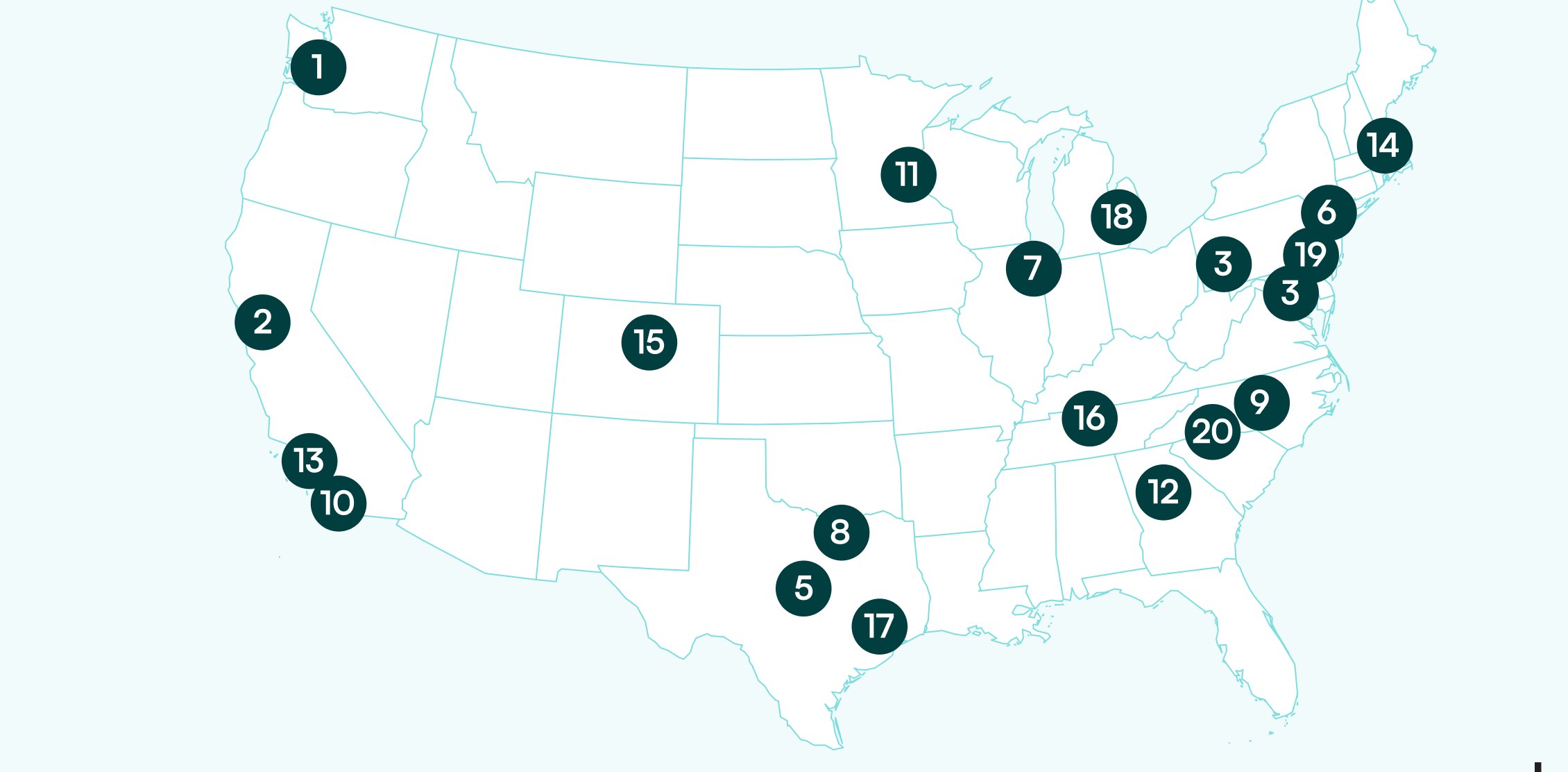

For the last two years, the narrative around software engineering talent was simple: talent was dispersing. Remote work, lower costs, and distributed teams were expected to flatten the global talent map. Companies (and top talent) were fleeing the coastal tech hubs in search of something different.
Karat’s 2026 Top Cities data shows a different reality. Engineering talent, and especially elite talent, is re-concentrating in a smaller number of high-density hubs. At the same time, a new class of AI-driven cities is emerging, reshaping how and where companies should hire.
Below is a table of the top 20 U.S. cities for engineering talent in 2026, and three key trends shaping America’s technology workforce. The rankings are based on each city’s concentration of elite software engineering talent as determined by technical interview performance. Full methodology can be found here.
Top 20 U.S. Cities for Engineering Talent (2026)
| U.S. Rank | City | % of engineers in top quartile | Median SWE comp | Workforce size* |
| 1. | Seattle | 38.2% | $247,250 | 115,000 |
| 2. | San Francisco | 34.8% | $272,229 | 228,000 |
| T-3 | Pittsburgh | 27.8% | $140,000 | 32,000 |
| T-3 | Washington, D.C. | 27.8% | $154,000 | 81,000 |
| 5. | Austin | 27.5% | $182,080 | 53,000 |
| 6. | New York | 26.6% | $190,000 | 110,000 |
| 7. | Chicago | 26.5% | $144,500 | 46,000 |
| 8. | Dallas | 26.4% | $132,500 | 46,500 |
| 9. | Raleigh / Durham | 25.6% | $141,000 | 50,000 |
| 10. | San Diego | 25.5% | $189,300 | 55,000 |
| 11. | Minneapolis | 24.8% | $127,580 | 26,500 |
| 12. | Atlanta | 24.3% | $145,000 | 60,000 |
| 13. | Los Angeles | 24.2% | $170,000 | 63,000 |
| 14. | Boston | 23.6% | $166,000 | 56,000 |
| 15. | Denver | 23.3% | $160,000 | 40,000 |
| 16. | Nashville | 22.9% | $150,000 | 20,500 |
| 17. | Hoston | 20.9% | $132,000 | 22,000 |
| 18. | Detroit | 19.6% | $120,000 | 43,000 |
| 19. | Philadelphia | 17.5% | $130,000 | 25,500 |
| 20 | Charlotte | 16.9% | $121,350 | 21,000 |
*Workforce size based on the estimated number of software engineering and software-adjacent roles. Geographies include the broader metropolitan area (i.e., Seattle includes Bellevue and Redmond; San Francisco includes Oakland and San Jose, etc.)
Trend 1: Top talent is re-concentrating in major tech hubs
Despite years of discussion around distributed work, elite engineering talent is increasingly clustering in the traditional ecosystems.
Cities like Seattle and San Francisco didn’t just remain competitive. They separated themselves from the pack.
Why?
Because AI development is not evenly distributed work.
According to McKinsey & Company, companies investing in AI are increasingly centralizing high-skill roles to accelerate innovation, noting that organizations are prioritizing “deep technical talent in core hubs to drive outsized impact.”
Similarly, CBRE Group’s annual tech talent report shows that the largest U.S. tech markets continue to gain share of high-skill workers, even as smaller markets grow in absolute terms.
What’s happening:
- AI work requires tight collaboration across senior engineers
- Infrastructure and platform work concentrates in major hubs
- Top engineers prefer environments with other top engineers
Karat’s data shows that top-quartile engineers are disproportionately generating value from their use of AI, becoming significantly more productive than their peers.
That dynamic reinforces the advantage of cities like Seattle (cloud + AI infrastructure), San Francisco (AI research + frontier models), and New York (applied AI in finance and media).
According to the Stanford Institute for Human-Centered AI, organizations deploying AI effectively are increasingly dependent on highly skilled engineers capable of integrating and scaling these systems, not just using them. And as more organizations get clarity on their AI roadmaps, this is generating even more demand for highly skilled tech workers.
Trend 2: Enterprise Cities Are Rising Fast
While traditional tech hubs remain dominant, enterprise-driven cities are climbing the rankings quickly.
Cities like Chicago (7th in the U.S.) and Dallas (8th in the U.S.), as well as Minneapolis and Atlanta, which finished just outside of the U.S. top-10, are climbing. These markets are benefiting from massive investments in financial services modernization, industrial AI, investments in healthcare technologies, and logistics and supply chain platforms.
According to Deloitte, over 70% of large enterprises are increasing AI spending in core operations, not just digital products, and that is attracting workers seeking stability in a volatile jobs market.
That investment is driving demand for high-skill engineers outside traditional tech companies.
In these enterprise markets, engineers are embedded in complex, real-world systems. AI is being adopted to drive large-scale operational challenges.
Trend 3: The emergence of new AI hubs
Perhaps the most interesting shift is the rise of next-generation AI ecosystems.
Pittsburgh: the breakout AI city
Pittsburgh is this year’s biggest riser.
Long known for robotics and academic research, it is now producing commercial AI companies and AI-first product teams.
Companies like Duolingo are embedding AI into their core product strategy, while autonomous systems companies and research spinouts continue to scale.
According to Carnegie Mellon University, one of the world’s leading AI institutions, the region has become a major pipeline for applied AI talent entering industry and a hotbed for the new skills required to thrive in a human + AI enterprise.
What This Means for Engineering Leaders
- Double down on elite talent hubs. Markets like Seattle and the Bay Area still offer the highest concentration of top-tier engineers.
- Don’t overlook enterprise-driven cities. Chicago, Dallas, Atlanta and Minneapolis are producing increasingly strong engineering talent.
- Watch emerging AI ecosystems closely. Cities like Pittsburgh are small but rapidly gaining importance.
The idea that software engineering talent would disperse evenly across geographies is giving way to a new reality. AI is driving a re-concentration of talent into the markets best equipped to support high-skill, high-impact engineering work.
The companies that understand this shift — and align their hiring strategies accordingly — will be the ones that move fastest in the AI era.
FAQ: Engineering Talent by City
What are the best U.S. cities for engineering talent in 2026?
Karat’s 2026 rankings show that cities like Seattle and San Francisco lead in engineering talent quality, with emerging hubs such as Austin and Washington, D.C. continuing to grow.
How is engineering talent quality measured?
Karat measures engineering talent using performance data from over 600,000 real technical interviews, focusing on problem-solving ability, coding skills, and system design.
Which cities have the strongest software engineers?
Top-performing engineers are concentrated in a small number of cities, with Seattle consistently ranking highest in overall engineering talent quality.
Are emerging tech hubs catching up?
Emerging tech hubs like Austin and Denver are growing rapidly, but top-tier engineering talent remains more concentrated in established markets like Seattle and San Francisco.
Why does engineering talent vary by city?
Engineering talent varies by city due to differences in education pipelines, industry presence, hiring standards, and access to experienced engineering communities.
How is this different from other tech talent rankings?
Unlike rankings based on headcount or salary, Karat’s data is based on real technical interview performance, providing a clearer view of engineering talent quality.
Explore the Full Global Talent Map
The top-10 U.S. cities tell an important story, but they’re only part of a much larger shift happening across global engineering talent markets.
From rapidly rising AI hubs to enterprise-driven metros gaining momentum, the full Top 40 rankings provide a deeper view into where elite software engineers are concentrated, and where new opportunities are emerging.
Explore the full Top 40 Cities for Engineering Talent to see how your current hiring markets stack up and where to look next as you build your workforce strategy in the AI era.
Related Content

AI Hiring
09.16.2026
To assess engineering skills in financial services, organizations should define the competencies needed for each role, develop interview content that measures both foundational engineering and AI skills, evaluate candidates in realistic environments, and standardize their interviews and scoring. By taking these steps, you’ll be able to reliably identify software engineers who can build secure products […]

AI Hiring
08.24.2026
In every issue of The Talent Signal newsletter, Karat Co-Founder and President Jeffrey Spector explores the trends reshaping technical hiring. From changing skill requirements to new hiring challenges, the series helps engineering leaders understand how the broader landscape is changing software engineering and what it means for building high-performing teams. One of the biggest themes […]
AI Hiring
07.01.2026
Financial services engineering leaders are tasked with modernizing legacy systems, shipping new digital products, and navigating an AI revolution – all while competing with big tech and fast-growing startups for increasingly scarce engineering talent. To better understand where FinServ engineering leaders are feeling the most pressure, Karat analyzed data from 303 CTOs, CIOs, VPs of […]