Reports
Survey: How AI Is Transforming the Engineering Workforce in Financial Services
Download Report

AI is fundamentally changing how software is built. In financial services organizations, that shift is colliding with legacy systems, regulatory needs, and top-down pressure to maximize the efficiency of technology head counts and spending.
While most companies are investing in AI tools, far fewer banks are modernizing how they evaluate, deploy, and scale engineering talent in an AI-augmented world. The result is a growing gap between financial services organizations and leading technology companies in productivity, AI readiness, and engineering quality.
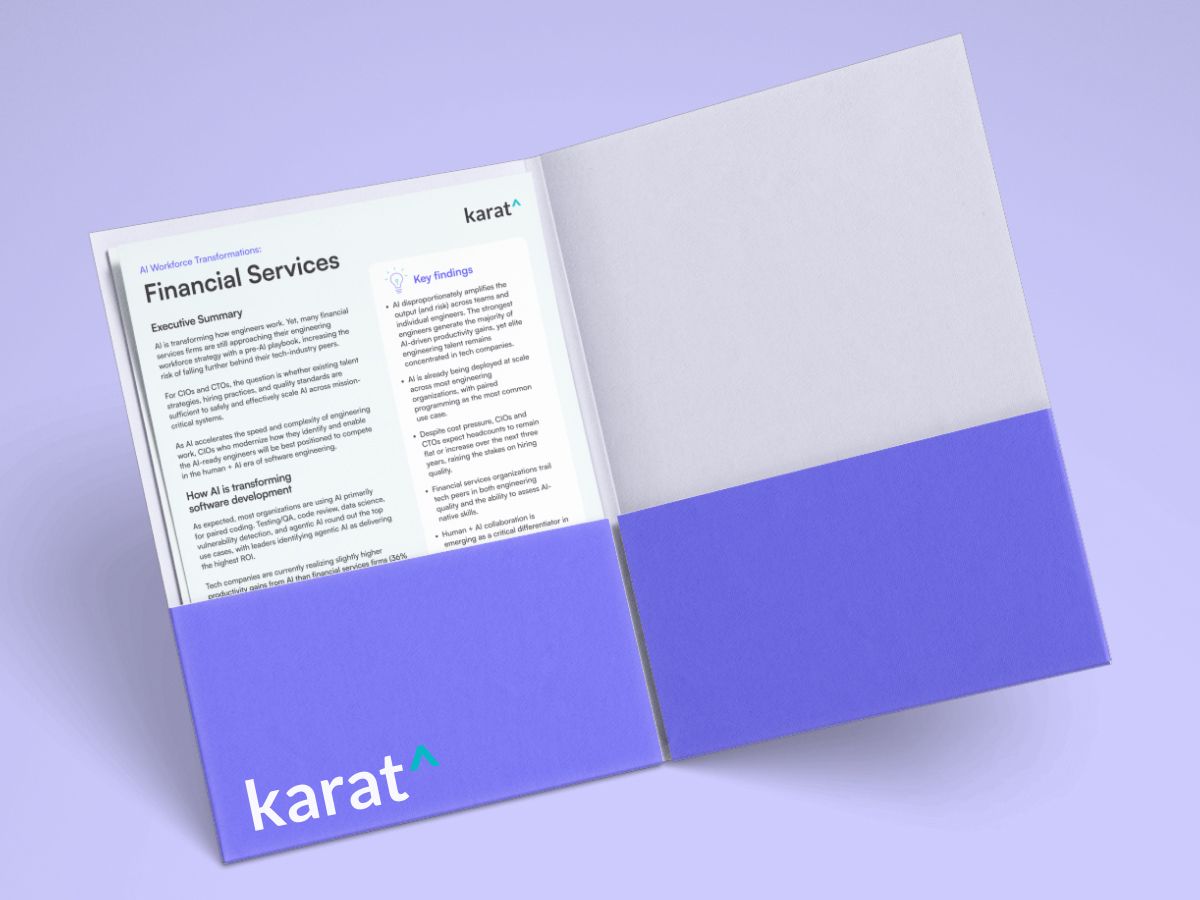
Karat’s AI Workforce Transformation Report for Financial Services provides a data-driven look at how AI is reshaping engineering work—and what CIOs and CTOs must do to keep pace.
What’s inside the report
Based on insights from 400+ engineering leaders across the U.S., India, and China, this report examines how AI is changing engineering productivity, talent strategy, and hiring confidence in regulated enterprises.
FinServ engineering leaders will learn:
How AI is actually being used inside engineering teams
- The most common AI use cases across FinServ engineering organizations
- Why paired programming has become the dominant AI workflow
- Which AI applications leaders believe will deliver the highest ROI over the next 3–5 years
Why AI is widening the gap between strong and weak engineers
- How AI is disproportionately amplifying the productivity of top engineers
- Why many leaders now believe strong engineers are worth 3x or more their total compensation
- The growing risk of low-quality engineering talent in an AI-accelerated environment
Where FinServ is falling behind tech
- How FinServ compares to tech companies on AI readiness, adoption, and confidence
- How pressure to cut costs is limiting AI returns in regulated enterprises
- The hidden risks of relying on contractor and IT service provider talent without consistent quality benchmarks
Why traditional talent evaluations no longer work
- Why prohibiting AI in interviews creates a massive talent blind spot
- How take-home tests and automated coding challenges are losing predictive value
- Why confidence in hiring is declining—even as AI adoption increases
What next-gen, human + AI talent evaluation looks like
- How leading tech companies and Chinese firms assess AI-native engineering skills
- Why live, human-led interviews outperform AI-only or AI-prohibited approaches
- The measurable business outcomes organizations expect when they adopt human + AI interviews
Why this matters for CIOs and CTOs
In financial services, engineering quality is no longer just a delivery concern—it’s a risk, resilience, and competitiveness issue.
AI is accelerating development cycles, increasing system complexity, and raising the cost of poor technical decisions. Organizations that fail to modernize how they measure and enable engineering talent risk slower AI adoption, higher operational risk, and diminishing returns on AI investments.
This report offers a practical, data-backed roadmap for closing the AI talent gap between financial services and technology leaders without compromising security, fairness, or regulatory rigor.
Understand how AI is transforming the engineering workforce in financial services, and what leading organizations are doing differently to stay competitive.