AI Hiring
03.05.2026
How Karat’s Archetypes Standardizes Engineering Hiring in the AI Era

David Ro

AI has raised the stakes on every engineering hire. Most evaluation processes weren’t built for that. Here’s how the best engineering organizations are closing the gap.
For most of the last decade, growing engineering capacity meant growing headcount. You hired aggressively, accepted some variance in quality, and assumed that volume and velocity would carry teams through. With the recent advances in AI, that model is under pressure as headcount and capability are decoupling. A smaller team of strong engineers, proficient in using AI, can outperform a larger team with uneven talent.
Karat’s 2025 AI Workforce Transformation Report, drawing on a survey of 400 engineering leaders including 300 SVPs and CXOs across the U.S., India, and China, found that technology leaders estimate a 34 percent productivity increase from AI tools. But that gain isn’t evenly distributed. Strong engineers are compounding it; weaker engineers are struggling to keep pace. Nearly 59 percent of technology leaders now believe weak engineers deliver neutral or negative value in AI-enabled environments.
That reframes hiring entirely. Not whether to do it, but how much precision it demands. When individual leverage is high, the cost of a poor hire compounds and the margin for error shrinks. The shape of the answer is becoming clearer: it’s a systems problem, and systems problems require structure. Most engineering organizations haven’t approached it that way. Yet.
Why Inconsistent Engineering Hiring Is a Structural Problem
CTOs apply rigorous standards to nearly every system their organization runs. Code gets reviewed. Architecture gets documented. Infrastructure has defined contracts, enforced interfaces, and observability into how things are performing. And yet, the process that determines how engineers are evaluated and hired often runs on completely different logic.
Consider what happens in practice. A senior backend engineer role opens on two different teams. Each runs their own interviews, applies their own mental model of what “qualified” looks like, and makes independent judgments. The aggregate result is that the same role title can mean meaningfully different things depending on which team you join. Multiply that across roles, levels, regions, and hiring cycles and the problem gets built into how your organization hires. It shows up as stalled roadmaps, increased technical debt, and teams that can’t deliver what you expected when it matters most.
The root cause isn’t bad judgment. It’s the absence of a defined, enforceable standard.
How Archetypes Create a Consistent Engineering Talent Standard
In software engineering, an interface defines a contract that multiple implementations must conform to. Different teams, different contexts, same underlying spec.
Karat’s Archetypes are the mechanism for turning an implicit standard into an enforceable one. Created and approved in partnership with engineering leaders, they are not an external standard imposed on your organization. They are your bar, documented and enforced at scale.
In practice, each Archetype defines what qualified looks like for a specific role and level: the technical skills required, how those skills are weighted relative to each other, and the calibrated bar candidates are measured against. Individual roles are defined within Role Manager and inherit their technical bar from an Archetype, while retaining team-specific context around domain focus and responsibilities. The implementations differ. The contract is consistent.
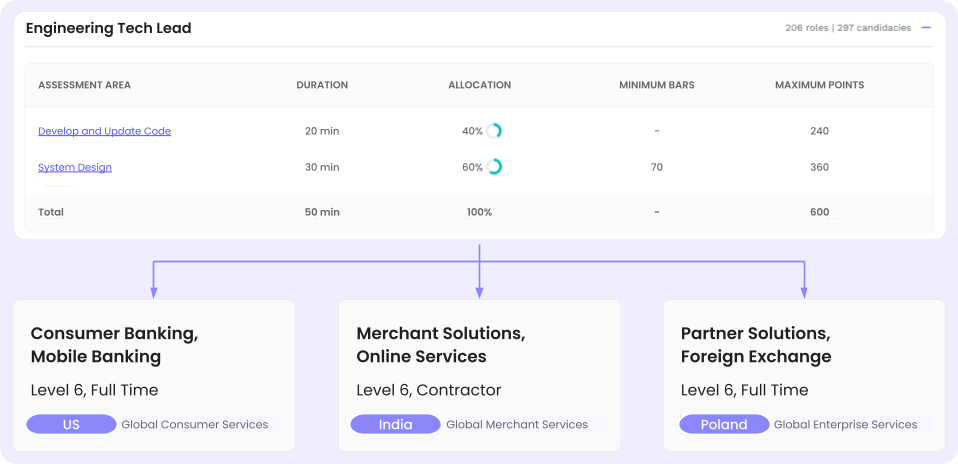
A concrete example: an Engineering Tech Lead Archetype at a financial institution might weight system design more heavily than developing and updating code. Those weightings are explicit, documented, and applied in every interview against that Archetype, regardless of which team is hiring or who conducts the interview. This is what makes a talent standard enforceable rather than aspirational.
At scale, the impact is tangible. A leading global bank runs over 50 Archetypes across five countries: India, Poland, the UK, Mexico, and China. Their hiring bar in Bangalore is the same as their hiring bar in London. That kind of consistency across teams, regions, and hiring cycles is exactly what Archetypes are designed to deliver.
How Karat Ensures Hiring Standards Are Applied in Every Interview
A well-defined Archetype solves the standards problem. It doesn’t solve the execution problem. The gap between what an Archetype says and what actually happens in an interview is where most hiring processes quietly lose consistency, not through bad intent, but through the ordinary variation of human judgment applied without a common anchor.
That gap is what Karat is built to close. Karat pairs each Archetype with a professional interview engineer, certified by Karat, who does more than execute a checklist. Human interviewers bring something no automated assessment can replicate: the ability to probe judgment, question trade-offs, and guide candidates through complex, ambiguous scenarios that reveal how they actually think and work. In an AI-enabled environment, where the differentiator isn’t who can produce code but who can make sound decisions, that human expertise is what surfaces the signal that matters. Every evaluation is anchored to the standard your organization has defined in its Archetypes, not a local team’s interpretation, not an interviewer’s personal bar.
To ensure that signal is consistent and measurable, every evaluation is scored against structured rubrics built by Karat from data across more than half a million interviews. These rubrics are specific to each Archetype, translating your defined competencies into consistent, scorable outcomes rather than subjective impressions. The result is evaluation that is comparable across candidates, teams, regions, and hiring cycles. The standard you defined is the standard being applied.
Why Visibility Into Interview Outcomes Keeps Hiring Standards Calibrated
Consistent evaluation produces consistent signal. And consistent signal means something more valuable than pipeline efficiency — it means an accurate, unbiased measure of actual talent quality. Get the standard right, keep it calibrated, and you stop making decisions based on who interviewed well on a given day and start building a clear picture of who is genuinely strong. The quality of your engineering org improves not just hire by hire, but systematically.
But a standard that doesn’t adapt becomes a liability. Karat provides role-level visibility into how candidates perform against calibrated standards over time, tracking whether evaluations are hitting the intended bar, where they’re drifting, and how standards are holding up as teams and hiring cycles evolve. That data enables continuous calibration at the level of the standard itself, not just individual hires. For example, if candidates are consistently falling short of the technical bar defined in an Archetype, that’s a signal worth investigating, whether the bar needs recalibration or the pipeline feeding it needs attention.
Visibility at that level is what keeps a talent standard honest over time.
Karat Delivers a Proven Engineering Hiring System That Can’t Be Replicated
As individual leverage increases, talent quality becomes a more significant variable in engineering outcomes. That makes consistency of evaluation a competitive variable, not an operational nicety, and it makes the question of who owns that problem a first-order engineering decision, not an HR one. Most engineering leaders recognize this. Karat is built to answer it.
Some engineering orgs attempt to solve this internally, writing down standards, training interviewers, building rubrics. The problem isn’t effort. It’s that the foundation Karat has built can’t be replicated. Calibrated rubrics, a vetted network of professional interview engineers, and a proprietary dataset built across hundreds of roles and levels are not things you can assemble from scratch and expect to work. Nor do you need to. Karat’s implementation, deployment, and content teams handle the transition end to end, from translating your existing standards into Archetypes without disrupting live hiring pipelines, to recalibrating as your needs evolve.
That dataset spans more than half a million interviews conducted across Fortune 500 companies including Citi and PayPal, spanning tech, finance, healthcare, and beyond. That kind of depth and breadth isn’t the result of good intentions. It’s the result of a system proven over hundreds of thousands of interviews and years of deployment.
The data, the calibration, the years of refinement across hundreds of roles and industries — it’s already built. What your organization gets is a talent system proven across the world’s leading companies, ready to make engineering quality a measurable, improvable outcome rather than an assumption.
Engineering quality is designed, not discovered. If you’re ready to treat your talent system with the same rigor as your technical systems, that’s what Karat is built for. Learn more at karat.com.
FAQs
How does Karat help standardize engineering hiring?
Karat helps organizations standardize engineering hiring through Archetypes, which define the technical competencies, evaluation criteria, and hiring bar for specific roles and levels. These Archetypes allow companies to evaluate candidates consistently across teams, roles, and regions.
How does Karat give organizations visibility into their Archetypes?
Karat’s Role Manager gives engineering and TA leaders a centralized view of every Archetype available to their organization, a single place to see how roles are defined and what standards are being applied across teams. Archetypes are created and approved by engineering leaders in partnership with Karat, then made available through Role Manager so every team is hiring against the same calibrated bar regardless of where they’re located.
Why is consistency important in technical interviews?
Consistency ensures candidates are evaluated against the same technical bar regardless of who conducts the interview or which team is hiring. Without consistent standards, companies risk hiring engineers with very different skill levels for the same role.
How does AI change engineering hiring?
AI tools increase the productivity of strong engineers while exposing skill gaps in weaker ones. As a result, hiring decisions have a greater impact on engineering outcomes, making precise and consistent evaluation more important than ever.
Related Content
AI Hiring
03.11.2026
A Practical Guide for Training Interviewers in the Human + AI Era AI use in technical interviews can be detected by observing candidate behavior, coding patterns, and reasoning during live interviews. Common signals include continuous screen switching, instant fully formed solutions, inconsistent explanations, and pasted code blocks.The most reliable approach is training interviewers to evaluate […]
AI Hiring
02.24.2026
AI-driven legacy modernization is quickly becoming a priority for financial services CIOs, but contractor governance frameworks have not kept pace. This week, two announcements signaled a structural shift for financial services technology leaders. Anthropic released a COBOL modernization playbook to accelerate mainframe transformation. At the same time, OpenAI unveiled its Frontier Alliances program with global […]
Interview Insights
02.18.2026
Same-day technical interviews are transforming how software teams compete for top engineering talent. By enabling candidates to schedule and complete interviews within hours of receiving an invite, companies dramatically improve time-to-hire, offer acceptance rates, and candidate experience. Learn how Karat's global network of trained Interview Engineers delivers scalable, 24/7 interview coverage—and why this operational edge is critical in the race for AI and software engineering talent.