AI Hiring
01.07.2026
Engineering Interviews in 2026: 3 Trends Hiring Leaders Must Prepare For (New AI Survey Data)

The Karat Team

AI is reshaping software engineering interviews. As AI becomes increasingly embedded in engineering workflows, it’s changing the skills that engineers need and disrupting the effectiveness of traditional technical interviews.
We surveyed 400 engineering leaders across the U.S., India, and China to understand how organizations are addressing this shift. Our data revealed five trends that will define how companies interview software engineers in 2026.
Trend 1: Why Are Strong Engineers Becoming More Valuable in the Age of AI?
Although we found that AI increases engineers’ productivity by an average of 34%, this boost doesn’t apply evenly across engineers. Instead of leveling the playing field, AI is widening the gap between strong and weaker engineers.
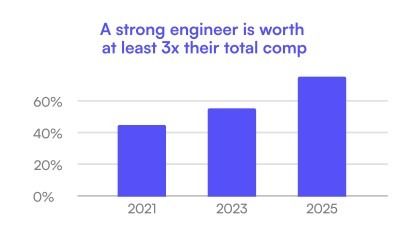
In our survey, 73% of leaders say strong engineers are worth at least 3x their total compensation. While the value of strong engineers has been increasing since 2021, the large jump from 2023 to 2025 reflects the impact of AI on productivity. Strong engineers who know how to effectively leverage AI create more value by automating routine work, accelerating development, and exploring more ideas.
To accurately identify strong engineers, interviews have to go beyond assessing whether the candidate provided the correct answer. They need to also assess the candidate’s judgement, adaptability, and AI fluency. These qualities are what set strong engineers apart from others in an AI-enabled world.
Trend 2: Why Are Traditional Technical Interviews Failing in an AI-Enabled World?
Generating a predictive hiring signal has always been challenging, but AI has made it even more difficult. Not only is AI expanding the skills required to be a great engineer, it is also disrupting the way most companies measure those skills. Our data found that 71% of leaders say AI is making technical skills harder to assess.
Software engineers now use AI to produce functional code in seconds. That is part of the job, and at most companies, leveraging AI for this kind of efficiency is both encouraged and expected. Over-indexing on a candidate’s ability to do this independent of AI, doesn’t paint an accurate picture of how they’ll work in real life. This means that two of the most popular established methods of creating a technical interview signal are no longer effective:
- Code tests were designed to evaluate problem-solving and coding abilities. With AI, candidates can paste a prompt into an AI assistant and instantly receive a working solution. It’s nearly impossible to distinguish between someone who understands the underlying concepts and someone who is simply relaying AI-generated code.
- Take-home projects are used to assess how engineers approach larger, more realistic tasks in their own environment. Similar to code tests, take-home projects only look at the candidate’s final output. Interviewers also lack visibility into the candidate’s process.
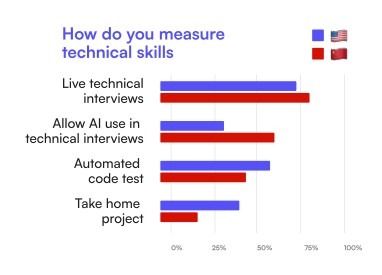
In 2026, companies that still rely on these methods of generating a hiring signal will struggle to make confident hiring decisions. Accurately assessing engineers with AI in the picture requires a shift in strategy. As the hiring signal from take-home projects and automated tests degrades the fastest under AI, live interviews are now more valuable because they allow interviews to observe how candidates work through a problem, make decisions, and use AI.
Organizations can look to China for a blueprint on how to effectively assess the skills that are most relevant today. Chinese companies are nearly 2x more likely to allow AI in live interviews, and less likely to use take-home projects and automated tests.
Trend 3: Why Human-Led, AI-Enabled Interviews Deliver Better Hiring Outcomes
AI use in engineering interviews is not only inevitable, but it’s also necessary for better hiring outcomes.
We found that over half (62%) of organizations still prohibit AI use in technical interviews. This means they’re not assessing AI skills, despite the fact that an increasing number of engineers are either already using AI or planning to use AI tools in their development process.
Preventing AI cheating in interviews also seems futile, as tech leaders estimate that over half of candidates use AI despite being instructed not to. Instead of getting an accurate hiring signal, this tactic just obscures the use of AI.
Whether companies want to allow AI in interviews or not, there’s good reason to embrace it. Organizations that use human + AI hiring assessments anticipate better outcomes over the next three years:
- 63% expect coding errors to decrease.
- 49% expect the time it takes to bring new products/features to market to decrease.
- 76% expect the number of products and features they release to increase.
Human + AI interviews combine a live interviewer with an environment where candidates are allowed and expected to use AI tools. The interviewer is able to observe how the candidate arrived at their solution and see how they worked with AI. This format mirrors real engineering work, where engineers will collaborate with AI, evaluate AI output, and resolve AI hallucinations or biases. It also identifies engineers who are skilled in using AI but not dependent on it.
Talent Measurement Has Become a Continuous System
Forward-thinking organizations are no longer treating talent measurement as a static assessment. They’re building human + AI systems that evolve with AI advancements.
High-performing companies use these three best practices to create a continuous system for measuring talent and adjusting their hiring bar:
- Measure what matters. Update interview content, rubrics, and interviewer training to align with the skills that actually drive performance in an AI-enabled environment. Skills such as writing clean and efficient code, language syntax, and understanding data structures and algorithms used to be critical competencies. They have become less important while skills like problem-solving, adaptability, and AI collaboration have become more valuable.
- Reward and replicate top performers. Since engineers with both strong foundational skills and AI fluency produce the most value, leading companies use human + AI assessments to identify those engineers. They align compensation, promotion, and project assignments accordingly to attract and retain strong talent.
- Continuously recalibrate as AI evolves. AI tools, models, and best practices evolve rapidly. Leading organizations view talent measurement as a living system that needs to be regularly updated with new data, insights, and benchmarking. This ensures that their hiring process remains relevant, accurate, and effective.
Our data clearly shows that engineering interviews are evolving, and must evolve. AI is eroding the signal from traditional interview methods. Organizations that don’t update their interview process will struggle to identify top talent, while those that embrace human-led, AI-enabled interviews and continuously adapt their strategies are set to consistently hire strong engineers in 2026 and beyond.
To dive deeper into the data behind these trends and learn more about how organizations are identifying AI-ready talent, download our 2025-2026 AI Workforce Transformation Report.
Related Content
AI Hiring
03.11.2026
A Practical Guide for Training Interviewers in the Human + AI Era AI use in technical interviews can be detected by observing candidate behavior, coding patterns, and reasoning during live interviews. Common signals include continuous screen switching, instant fully formed solutions, inconsistent explanations, and pasted code blocks.The most reliable approach is training interviewers to evaluate […]
AI Hiring
03.05.2026
AI has raised the stakes on every engineering hire. Most evaluation processes weren’t built for that. Here’s how the best engineering organizations are closing the gap. For most of the last decade, growing engineering capacity meant growing headcount. You hired aggressively, accepted some variance in quality, and assumed that volume and velocity would carry teams […]
AI Hiring
02.24.2026
AI-driven legacy modernization is quickly becoming a priority for financial services CIOs, but contractor governance frameworks have not kept pace. This week, two announcements signaled a structural shift for financial services technology leaders. Anthropic released a COBOL modernization playbook to accelerate mainframe transformation. At the same time, OpenAI unveiled its Frontier Alliances program with global […]