Uncategorized
11.03.2026
What Skills Do Software Engineers Need in the Age of AI?

Gordie Hanrahan

In the age of AI, great engineers stand out not just for their coding ability, but for their judgment, systems thinking, problem framing, and ability to direct and evaluate AI. As AI takes on more execution work like coding, engineers who create the most value are those who can turn ambiguous problems into reliable technical solutions and orchestrate human and AI work to achieve meaningful business outcomes.
AI isn’t just changing which skills are most valuable. It’s also amplifying the difference between low- and high-performing engineers. Globally, 75% of tech leaders say a strong engineer is worth at least 3x their total compensation. This is up from 45% in 2019. Although it was thought that AI would equalize differences in performance, this finding from our 2026–2027 AI Workforce Transformation Report shows that leaders increasingly believe the opposite.
To understand why these capabilities are becoming more valuable, it helps to first look at how AI is changing the work engineers do.
How Is AI Changing the Skills Software Engineers Need?
AI is making it easier to generate code, and this is changing how engineers spend their time. As engineers delegate coding to AI, they’re spending more time reviewing AI-generated outputs, refining requirements, designing systems, testing, and managing risk.
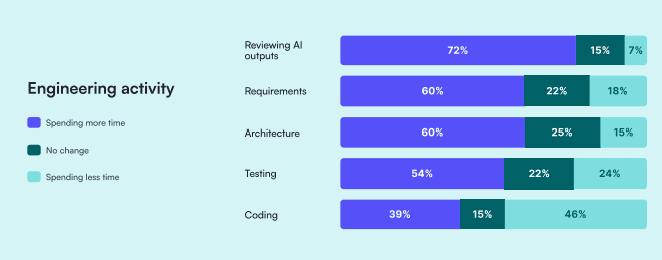
This shift in responsibilities is shaping the skills that matter most. Now, the ability to determine what to build, how to build it, and whether the solution is correct is what makes strong engineers stand out.
What Software Engineering Skills Matter in the Age of AI?
While technical fundamentals are still essential, AI is changing where engineers need to apply their expertise. These four capabilities have become particularly important as they allow engineers to make better decisions, navigate complexity, and use AI effectively throughout the development process.
- Technical judgment: AI can produce code that contains errors, introduce security vulnerabilities, or fail to account for important edge cases. Engineers need the technical judgment to distinguish between a reliable, secure solution and one that appears promising. Judgment also includes making informed decisions on architecture, trade-offs, and risk.
- Systems thinking: Engineers need to understand how local decisions affect the broader system. A change that solves an immediate problem might introduce technical debt, create unexpected dependencies, or compromise reliability elsewhere. Although AI can help generate and evaluate implementation options, engineers still need to make decisions in the context of the system as a whole.
- Problem framing: Before an engineer can solve a problem, they need to understand what the problem actually is. Engineers need to identify the underlying business need, ask clarifying questions, surface assumptions, and break ambiguous problems into manageable steps. This is important when working with AI, as the quality of AI output depends on how effectively an engineer defines the task, provides context, and establishes what a successful result looks like.
- Ability to direct and evaluate AI: To effectively work with AI, engineers need to decide how to divide the work, provide instructions and context, set expectations for the output, and verify that the results meet the requirements. David Lau, Vice President Workload Scaling at OpenAI, describes impactful engineers as those who are “constantly asking how best to combine the strengths of AI agents and human collaborators, structuring work so that each multiplies the impact of the other, and defining success criteria and work products that let agents demonstrate—clearly and verifiably—that they’ve achieved the desired outcome.”
Building High-Performing Engineering Teams in the AI Era
The future of software engineering involves AI taking on more implementation work while engineers remain responsible for the final solution and outcomes. That’s why the skills that distinguish great engineers are becoming most visible in the decisions surrounding the code: how they define a problem, weigh trade-offs, coordinate human and AI contributions, and determine whether a solution is ready to ship.
As the skills that make a great engineer have changed, the challenge for engineering and talent leaders is now identifying which candidates have these skills and adapting their assessments to measure them. With the value of strong engineers on the rise, being able to accurately identify which candidates are most likely to succeed on the job will be critical to assembling high-performing teams.
See how engineering talent value, skills, and workforce composition are changing in the full report.
FAQs
What are the skills software engineers need in 2027?
In 2027, software engineers will need strong technical fundamentals alongside critical thinking, problem-solving, communication, adaptability, and AI proficiency. The ability to define problems, make sound technical decisions, and direct AI tools effectively will become increasingly important.
Is coding still important for software engineers?
Yes. Engineers need strong coding fundamentals to evaluate AI-generated code, catch errors, and assess architectural decisions. However, coding ability alone is no longer enough to distinguish top performers. Engineers also need judgment and problem-solving skills to guide AI and ensure the quality of its output.
How should companies assess engineering talent in the age of AI?
AI engineering talent assessment should evaluate more than coding ability. Technical assessments should measure problem-solving, technical judgment, systems thinking, communication, and the ability to use and evaluate AI tools. For example, ask candidates to clarify an ambiguous requirement, explain a technical trade-off, or review an AI-generated solution and describe what they would verify before shipping it.
Related Content
AI Hiring
09.16.2026
To assess engineering skills in financial services, organizations should define the competencies needed for each role, develop interview content that measures both foundational engineering and AI skills, evaluate candidates in realistic environments, and standardize their interviews and scoring. By taking these steps, you’ll be able to reliably identify software engineers who can build secure products […]

AI Hiring
04.28.2026
What building and running the first human-led, AI-enabled technical interview system actually looks like When we launched Karat NextGen late last year, we had a clear thesis: the way companies evaluate engineering talent hadn’t kept pace with how software is actually built. AI tools had changed the job, but interviews were still designed for a […]

Global Hiring
04.21.2026
Toronto jumped nine spots in Karat’s 2026 ranking of the top cities for engineering talent to become the fifth city in the world for elite engineering talent, with 29.2% of candidates estimated to be in the top quartile globally. For years, Toronto has been on the rise as a tech hub. Now, it is North […]